
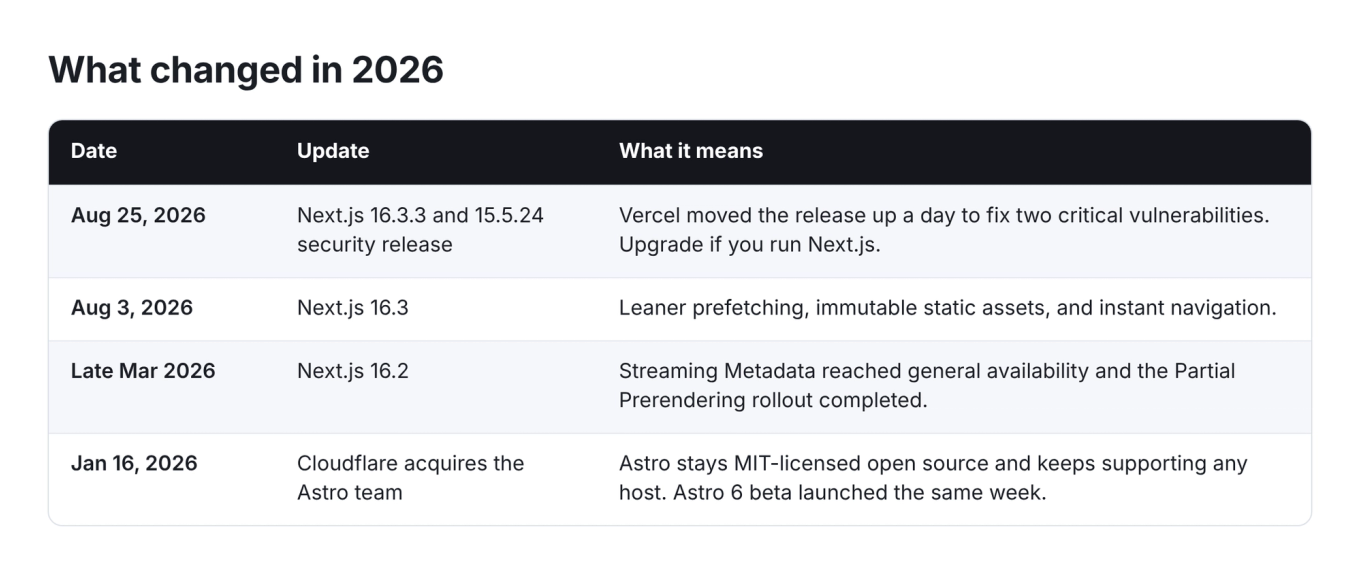
Astro changed owners and Next.js shipped two releases and a security fix in 2026. Here is the log, newest first.
What changed in 2026
Next.js vs Astro at a glance
Astro suits content sites and Next.js suits apps with logins and live data.
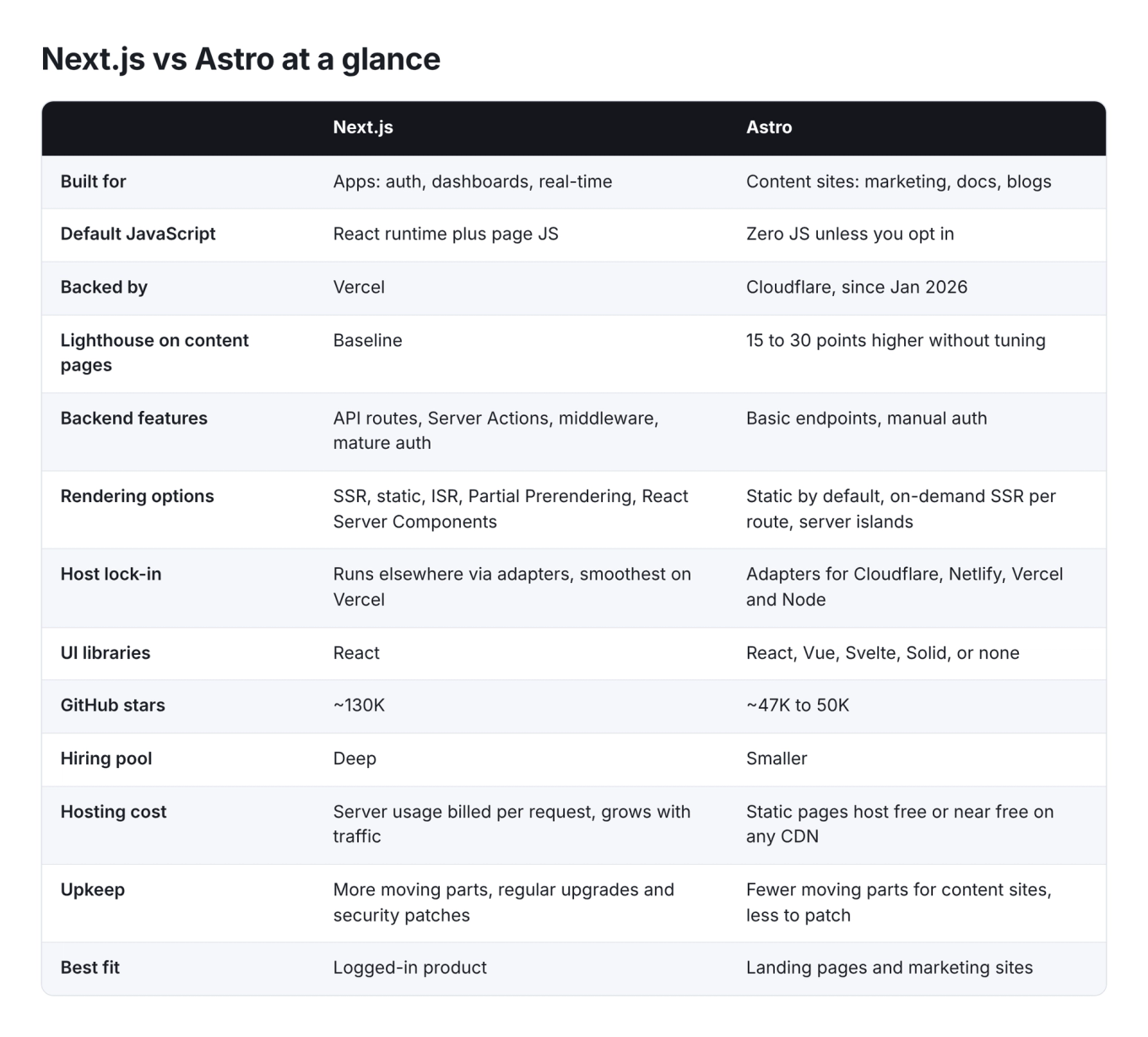
The Lighthouse gap is one migration guide's estimate for marketing sites, docs, and blogs. Star counts come from two comparison articles. Benchmarks vary by source, so test your own pages.
Which to pick
Pick Astro for marketing sites and landing pages, and Next.js for a logged-in product.
Pick Astro when:
- Most pages are content: landing pages, pricing, blog, docs, case studies.
- Page speed drives conversion and you want a strong Lighthouse score without tuning.
- Your team edits content far more often than app logic.
- You want to mix UI libraries. Astro runs React, Vue, Svelte, and Solid.
Pick Next.js when:
- Visitors log in and pages change based on who they are.
- You need API routes, Server Actions, middleware, or mature auth in one codebase.
- Your engineers already write React and you want the larger hiring pool.
- The site and the product share components and a design system.
Quick test: list every page on the site. If none of them depend on a user session, start with Astro. If a page needs to know who is looking at it, start with Next.js.
Plenty of teams run both, with Astro on the marketing site and Next.js on the product app. That split keeps the pages that drive pipeline fast and keeps app logic where the engineers already work. One migration guide estimates a content-site move from Next.js to Astro at 4 to 8 engineering days, and the reverse at 6 to 12, so a wrong first call is an inexpensive fix.
The framework delivers the page. The headline on it decides whether visitors stay, so see before and after UVP headline examples.
Want a second opinion on your stack? Book your sprint today.

 Maxx Bethke
 Matt Wilson


