
What a UVP Actually Is (And Why It's Not Optional)
Your unique value proposition is one sentence: what you do and who it’s for, that nobody else does as well. Specific. Concise. Clear enough to be understood by an idiot in a hurry.
That's it. Not a tagline. Not a features list. One sentence, sitting at the exact spot where three things overlap:
Uniqueness. Value. Relevance.
Here's why a UVP is not a nice-to-have. Barriers to entry have never been lower for B2B SaaS. Every category has competitors saying some version of "all-in-one platform for teams." Buyers can't tell you apart and sales struggle to tell a unique story.
A sharp UVP is the cornerstone for your entire go-to-market. It’s the foundation for who you’re targeting, where to find them and crafting messaging that converts. Get this wrong, and you decrease the efficiency of your marketing spend. The death knell for go-to-market leaders.
This is also where niching down earns its keep. A UVP for everyone is a UVP for no one. The narrower your UVP, the cheaper it gets to reach them.
Signs Your UVP Needs Tightening
If any of these signals are visible within your business, it may look like a go-to-market problem, but it could be a positioning problem.
- Lead volume is low. Nobody self-selects into a pitch they can't understand.
- Leads are outside your ICP. Vague positioning attracts vague-fit buyers.
- Website bounce rate is high. If visitors can't answer "is this for me?" in five seconds, they leave.
- Messaging is inconsistent across touchpoints. Ads say one thing, sales say another, the site says a third, every mismatch is a buyer wondering what's actually true.
These problems don’t have to be endemic. Taking the time to understand clearly who you’re for and why can bring about the focus you need to reimagine your go-to-market.
How to Start Shaping It
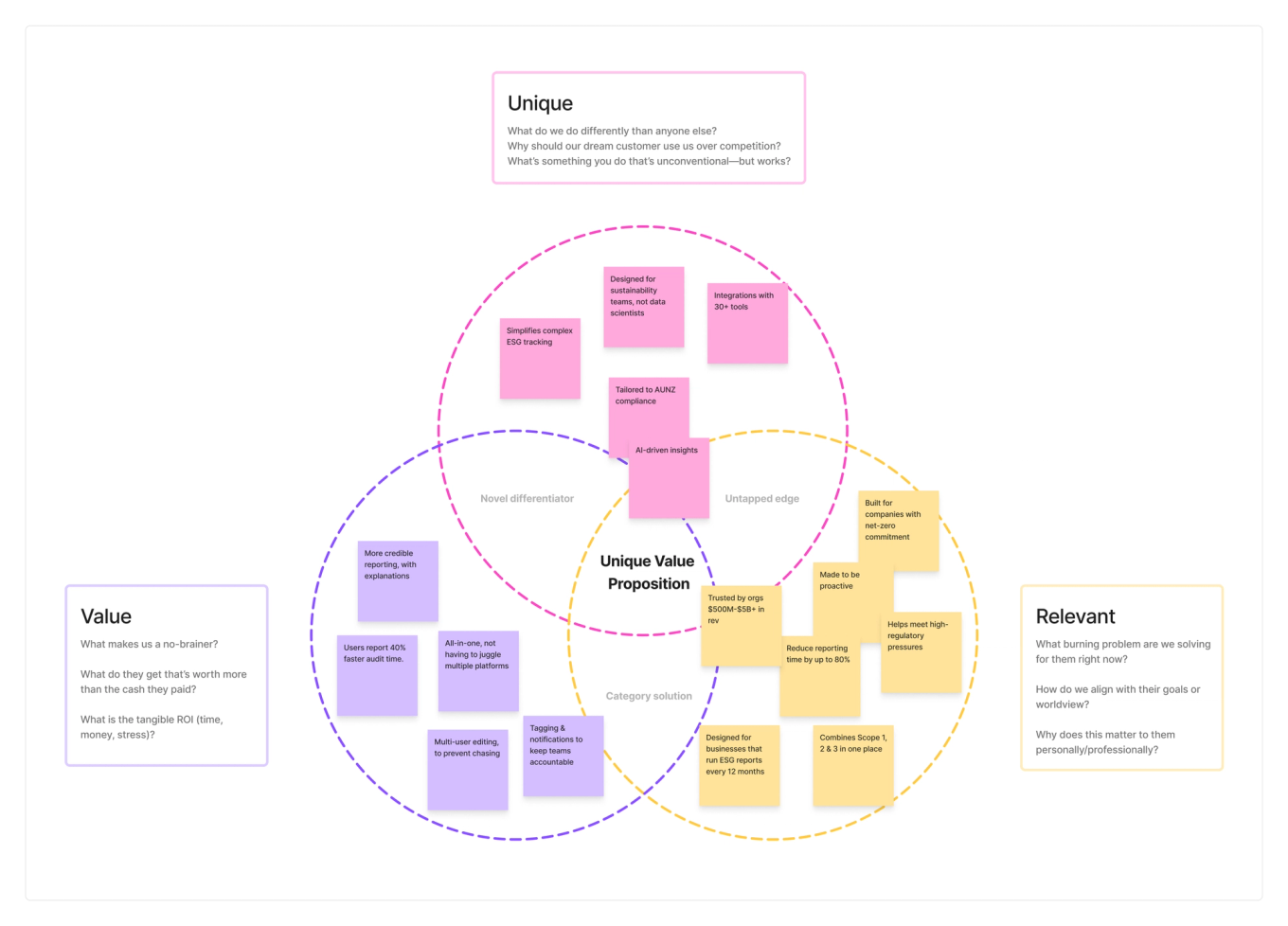
Creating a UVP is not a brainstorm exercise. It’s refining the deeply held knowledge within the business on why you exist. Create a board and start putting post it notes in the following circles;
1. Unique — What would your buyer do without you? List the real alternatives (a competitor, a spreadsheet, nothing). What you do that none of them do.
2. Value — Take every feature and ask "so what?" until it sounds like a benefit.
"Real-time sync" → so what? → "you stop deciding on bad numbers."
3. Relevant — Talk to customers who'd be genuinely upset if you vanished. What do they share? That's your real audience.
Slack didn't pitch "another chat app", it pitched itself against email. Drift didn't out-feature live chat, it coined "conversational marketing." Same move both times: find where all three circles overlap, then say it in one sentence.
Draw your three circles. Fill them in honestly. Then ask the only question that counts:
What's true in all three at once?
That sentence is your UVP. Write it down. Test it on the next five prospects. Are they reaching the ‘aha’ moment faster than before? If they ask "wait, what?", start back at circle one.
If you’re looking for guidance by experts who have run this process with 100s of B2B SaaS start-ups, get in touch here.

 Matt Wilson
  Maxx Bethke

